
 ChatGPT
  Perplexity
  Gemini
  Claude AI
 Hospitality doesn’t lose revenue because demand evaporates. It loses revenue because customers exit support journeys before value is captured.
When guests are forced to repeat themselves, wait through dead air, or restart calls that collapse under load, they don’t escalate; they leave. Bookings go unmodified. Cancellations go unsalvaged. Ancillary revenue never materializes.
The friction is structural. Most hospitality support systems are built to route calls before they understand why the call exists.
Instead, intent-first architecture changes that order, reshaping how hospitality support captures value, protects capacity, and performs under pressure.
Constraints of Legacy Call Center Operations
Most hospitality legacy call center system is predictable, time-sensitive, and linear. Each transition adds latency, which snowballs to abandonment.
This gap becomes obvious when contrasted with how some industries have successfully adapted to intent-first operations.
Recently, I had an interaction with a large financial service provider for a potentially fraudulent transaction. While I expected a long IVR menu, waiting to connect with an agent, verifications, and follow-ups. I was surprised when the system presented context-aware options, executed appropriate action in real-time, raised a formal dispute automatically, and confirmed it before the call concluded.
No IVR. No waiting.
This worked because the intent was identified which allowed the system to act in real-time.
Hospitality can offer the same confidence and closure with intent-first architecture.
The Architecture Shift That Makes This Possible
Customers prefer when their needs are immediately acknowledged.
So, when a support system opens with something like, “Are you calling about a cancelled flight due to the storm?” frustration drops immediately.
The customer no longer needs to restate context. The system is already aligned:
- Intent-first architecture enables this by changing where and when intent is recognized.
- Instead of waiting for a completed dialogue turn, intent is inferred continuously from streaming audio.
- That shift turns intent from a downstream classification step into an upstream control signal.
- Workflows are pre-warmed, and even re-bound while the user is still speaking.
- Downstream services can fetch data in parallel with speech, ensuring routing decisions happen before the customer perceives a handoff.
As a result, the system shifts from sequential request–response execution to a streaming, event-driven control loop.
A few days back, when I called the support of a leading retail brand after accidentally cancelling the wrong order, I needed the cancellation reversed. I expected the usual back-and-forth, but instead, a bot understood the confusion immediately and resolved it within the same interaction.
This structural shift is what reduces latency.
Average latency drops because speech input, intent inference, and backend actions are executed in parallel. Tail latency collapses because failure loops disappear. Misroutes, repeated clarifications, and late escalations are prevented at the source.
When intent confidence is low or risk is high, the system escalates immediately. It does not attempt to recover through prolonged dialogue.
For this to work safely, action cannot depend on model confidence alone.
- Every action is gated by deterministic authorization layers that enforce policy, permissions, and idempotency.
- The model proposes actions, but the system approves them.
- The AI operates on verifiable, current state with transactional consistency to avoid race conditions or stale decisions.
- Intent confidence governs action scope and escalation thresholds by design.
When confidence degrades or ambiguity rises, the system must immediately defer to a human agent rather than attempting recovery through dialogue.
Intent-first, speech-to-speech systems generate highly variable load due to streaming audio, real-time inference, and backend orchestration during bursty call patterns. Cloud contact center infrastructure provides the elasticity to scale these components without pre-provisioning capacity. Event-driven architectures allow intent updates to trigger workflows instantly, while isolation and throttling contain failure during spikes.
Without cloud elasticity and regional resilience, early intent detection amplifies system fragility instead of improving responsiveness.
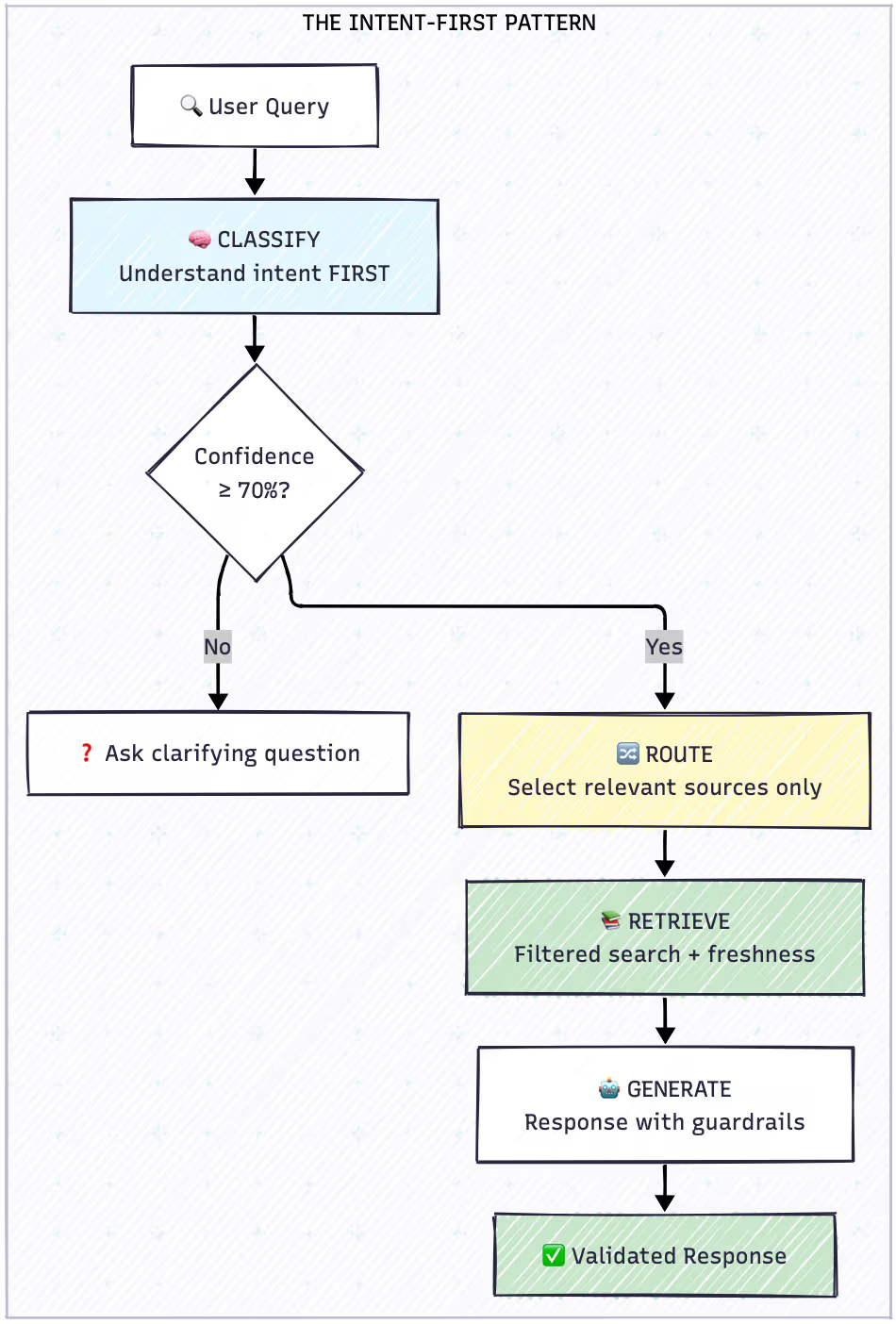
Image resource: Conversational AI doesn’t understand users — 'Intent First' architecture does
Operational Impact Under Real Hospitality Conditions
Architecture proves itself under stress.
Weather disruptions, mass cancellations, sudden inventory changes, and loyalty expirations are not edge cases in hospitality. They are predictable surge events. Under these conditions, legacy stacks degrade in familiar ways.
Intent-first systems behave differently because resolution happens before congestion forms.
High-volume, low-variance intents are identified immediately and completed autonomously. Cancellations, rebookings, confirmations, refund requests, and status inquiries are resolved at scale without entering agent queues. Even under burst conditions, the system absorbs predictable demand instead of forwarding it downstream.
This is how agent capacity is protected.
Human attention is reserved for situations where confidence drops, state becomes inconsistent, or emotional and policy complexity exceeds automation boundaries. Agents are engaged where human judgment actually matters.
The impact is operational clarity. Automation handles volume. Humans handle complexity.
This separation is only possible because intent is categorized early and structurally. Intent-first systems group hospitality calls by actionability and risk, not surface phrasing.
Core categories include
- Transactional intents: book, modify, cancel, refund
- State inquiry intents: availability, pricing, booking status, check-in/out timing
- Disruption-driven intents: weather rebooking, overbooking resolution, mass cancellations
- Account and loyalty intents: points balance, expiration, tier benefits
- Policy clarification intents: fees, guarantees, exceptions
- Emotionally escalated intent: complaints, service failures, and perceived unfairness
This categorization ensures that low-risk actions are automated safely, surge traffic is absorbed intelligently, and complex situations reach the right human at the right time.
What Changes When Intent Is Recognized First
Intent-first AI is not a feature upgrade. It is a control-plane upgrade for hospitality support.
When intent is recognized first, the entire support dynamic shifts. Conversations begin with clarity instead of discovery. Systems act while value is still recoverable.
In hospitality, where disruption is constant and loyalty is fragile, acting on intent early is what separates operational strain from operational control.