

 ChatGPT
  Perplexity
  Gemini
  Claude AI
 Modern BFSI operates in a volatile environment, under the pressure to modernize aging systems in a tightly regulated sector. Legacy systems that has been the bedrock for financial operations cannot sustain the current market expectations.
Cloud lift-and-shift preserves the very constraints the institution aims to shed. Infrastructure may move, but latency, rigidity, and compliance blind spots remain intact.
An AI-first, event-driven architecture resets the foundation. It establishes a trustworthy operational core where decisions, controls, and analytics align with the real-time nature of financial activity.
Why Lift-and-Shift Preserves Trust Gaps
Simply moving existing systems to the cloud without re-architecting embeds foundational issues:
- Batch processing delays risk detection by hours or days, undermining fraud interdiction and AML monitoring.
- Rigid, monolithic workflows prevent runtime adaptability to evolving threats or market conditions.
- Fragmented data freshness leads to compliance exposures and inconsistent audit trails.
- Integration complexity inflates costs and increases operational fragility, especially under audit or high transaction volumes.
These legacy constraints perpetuate "trust breaks" where financial institutions cannot provide verifiable, timely, and consistent evidence required by regulators and stakeholders.
Key Pillars for AI-Ready BFSI Infrastructure
Cloud-native architecture enables rapid innovation, improved fault tolerance, and efficient resource utilization. For a successful AI modernization, BFSI organizations need three core elements working seamlessly.
1. Cloud-native architecture:
Cloud architecture helps financial institutions scale automatically with demand. This adjusts computing resources in real-time, ensuring usage-based billing while maintaining service quality.
Key components:
- Container orchestration for microservice deployment
- Serverless computing for event-driven processing
2. Data quality and governance:
Your AI’s performance is as good as your data. Poor data quality will create biased models. Modernizing data infrastructure will equip you with real-time quality monitoring, automated data tracking, and increased regulatory compliance.
Essential features:
- Zero-trust security to verify data access requests every time
- Encryptions to protect information in transit and at rest
- Real-time integration architecture
Instead of complete re-platforming, secure APIs allow standardized communication across platforms. While event-driven architecture responds to financial events as they occur.
Tech stack:
- AWS SQS for high-throughput message streaming
- Change data capture for legacy integration
- Event-driven architecture for decoupled service communication
Traditional Vs. Cloud-Native BFSI System
| Dimension | Legacy Systems | AI-First Cloud-Native Systems |
| Regulatory Audit Readiness | Manual, error-prone logs with inconsistent trails | Automated event sourcing with replayable, verifiable audit trails |
| Risk Detection Latency | Hours-day delay via batch processing | Milliseconds to seconds event-streaming risk insights |
| Model Governance | Spreadsheet-based, siloed model tracking | Integrated MLOps with lineage and drift detection |
| Compliance Posture | Baseline, reactive reporting | Proactive, real-time compliance monitoring |
| Operational Efficiency | Resource-intensive, static scaling | Elastic autoscaling, usage-driven resource optimization |
Execution Patterns for AI-First BFSI Modernization
Containerization, microservices, and orchestrated deployment models offer operational resilience and bridge technological advantages and regulatory imperatives.
1. From monolithic to microservice architecture
While the monolithic architecture has offered stability for financial institutions for decades, they present significant limitations in today’s landscape.
Transitioning to a microservice architecture helps decompose the application into loosely coupled services that communicate through well-defined APIs.
Note: This evolution aligns with domain-driven design, where architectural boundaries mirror the core financial capabilities, fraud, AML, credit, and payments, ensuring each service evolves at the pace its risk and regulatory demands require.
2. Event-driven architecture as the execution backbone
Event-driven architecture, characterized by asynchronous communication, offers a practical solution by decoupling producers of financial events from their consumers.
This architecture supports multi-layer governance:
- Real-time observability via distributed tracing and time-series telemetry
- Dynamic policy enforcement through control-plane rules
- Auditable decision flows captured in event logs and metadata layers
3. Containerization in financial workloads
Containerization provides consistent, isolated runtime environments. Platforms like Kubernetes enable BSFI organizations to manage the deployment, scaling, and operations of application containers across clusters of hosts.
4. Infrastructure as Code for financial deployments
IaC is a compelling solution for the complex financial system environment and the regulatory requirements. With declarative code that is version-controlled, tested, and deployed through automated pipelines, financial institutions can achieve robust compliance.
Conclusion
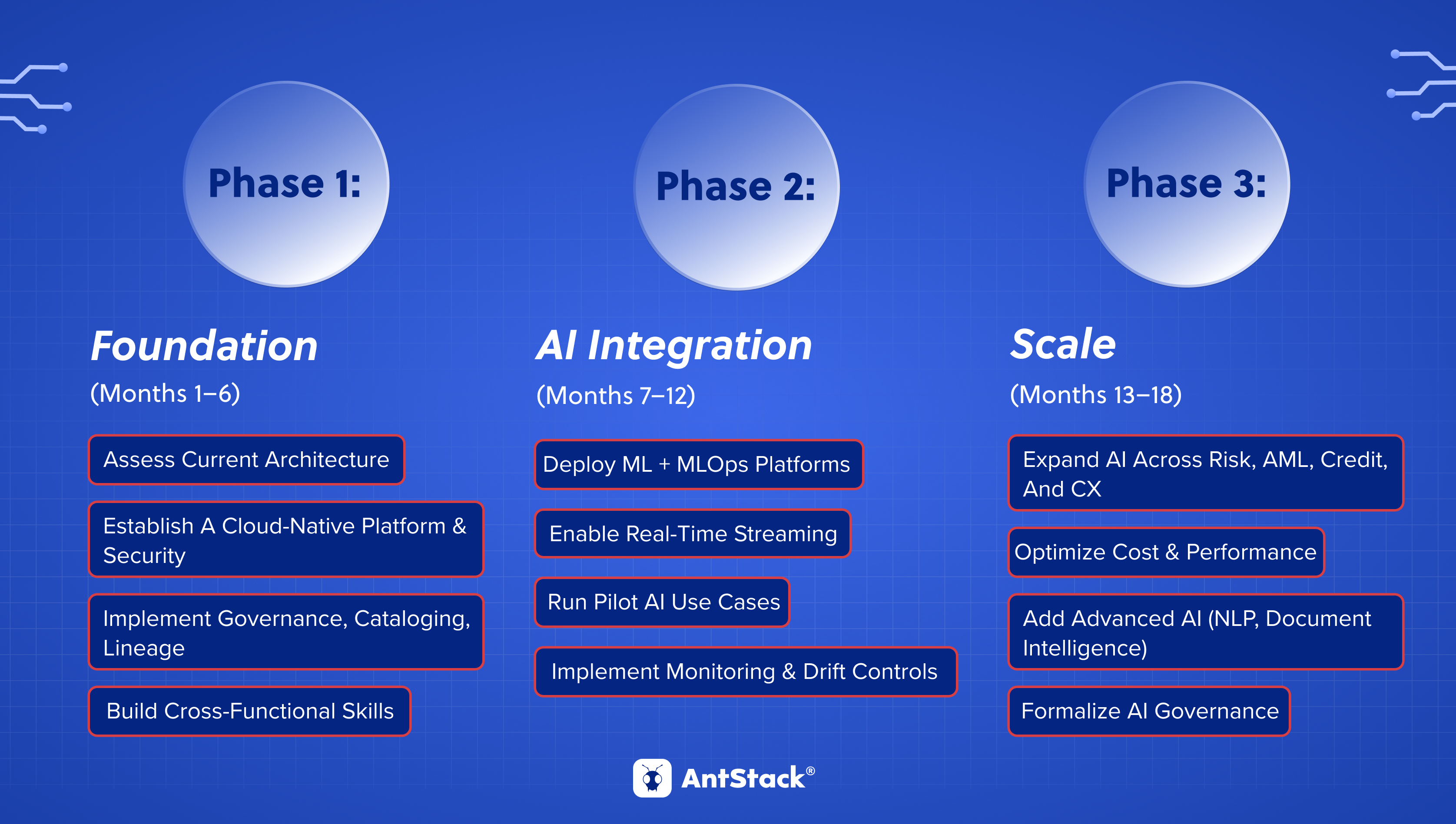
BFSI leaders face a structural mandate: shift from legacy, workflow-bound systems to AI-first, event-driven architectures that operate at real-time velocity. The institutions that modernize incrementally build platforms that scale, adapt, and withstand regulatory rigor.
The next wave of advantage goes to institutions that treat intelligence as core infrastructure, continuously refining models, streamlining controls, and elevating real-time decisioning as the engine of long-term resilience and growth.